
Sustainability Policy
Introduction
Aire Translations is a language services business run on a self-employed basis. I provide translations, subtitles, and other language-related services making use of translation and subtitling software, as well as desktop and online tools. I have a presence online via a website, portfolio sites and social media channels, and I mostly work from my home office.
Aire Translations' values
I run my business according to my values of respect for the environment and for other living beings. I’m Carbon Literate, and I understand the importance of protecting the natural environment and limiting the day-to-day impact of my business. I aim to follow and champion good sustainability practices, reduce the environmental impacts of my activities, and give something back to my community and the environment.
As a linguist, my mission is to use my language skills to make the world a better place by making content accessible to people.
Scope of this policy
This policy relates to how the services and operations within my business and across my supply chain will be continually reviewed and improved so that I can integrate environmental and social considerations into my everyday practices and make a positive contribution to society.
2025-2026 carbon footprint
Aire Translations’ emissions for the tax year 2025-2026 were around 1.69 tonnes CO₂e – to calculate this, I used the Small Business Carbon Calculator powered by Equipoise.
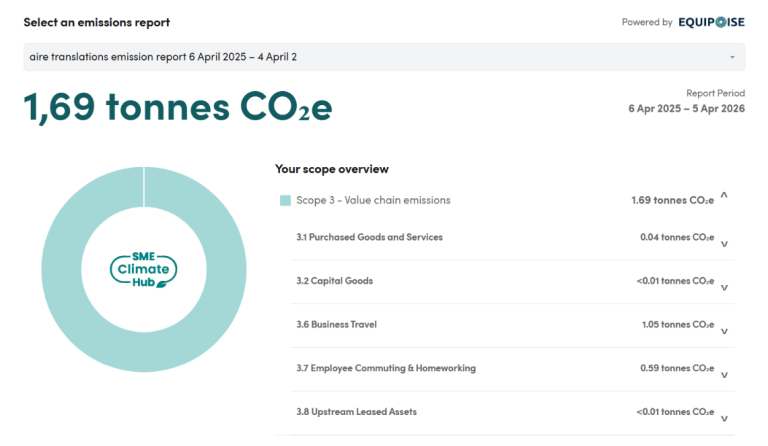
All the business emissions came from Scope 3 (value chain emissions). This is because the emissions from homeworking are classed under scope three as indirect emissions (if the business owned or leased separate premises, it would generate Scope 1 and Scope 2 emissions as well). Most of the emissions came from business travel (1.05 tonnes), followed by homeworking (0.59 tonnes), purchased goods and services (0.04 tonnes), capital goods (less than 0.01 tonnes) and upstream leased assets (less than 0.01 tonnes).
It’s worth noting that the homeworking figure is not based on information I entered on the calculator; it’s Equipoise’s estimate based on the amount of time I spend working from home when I’m not attending conferences, client meetings or networking events. This means that the energy-efficiency of my home doesn’t have an impact on this number.
What I'm doing
- I chose an electricity supplier who uses renewable energy.
- I have insulated my home to reduce the amount of energy spent on heating.
- At the end of each workday, I switch off my computer and other devices (i.e. electric sit-to-stand desk) by switching off the sockets.
- I don’t have a company (or personal) car. I cycle, use public transport or lift sharing to travel to any local business events.
- I travel to UK-based events by train and/or coach.
- I am vegan, and I advocate for veganism in the professional associations I am part of.
- I only use the printer if absolutely necessary.
- My website and email are hosted with a hosting provider that uses renewable energy.
- I buy second-hand or refurbished equipment whenever possible. My laptop is refurbished, and my monitor, keyboard, sit-to-stand desk, headphones and chair are second-hand. I will look for pre-loved before buying new.
- I don’t undertake work related to the promotion of fossil fuels, weapons and animal exploitation, among others.
What I'm working on
- When becoming Carbon Literate in summer 2026, I pledged to limit flights to 250 kg of CO₂e per year for business-related travel (roughly equivalent to one flight from Manchester to Barcelona per year). I cycle or use public transport to reach the majority of the events I attend.
- I endeavour to reduce waste. I travel with a reusable cup and other eating implements, and choose plastic free or recyclable packaging options whenever possible, or buy in bulk. However, I don’t lead a 100% zero waste lifestyle as it is difficult to avoid plastic packaging, and renovating a house creates waste.
- My business bank account is with Wise, which is not an ethical bank per se. I routinely look for alternatives that allow me to deal with multiple currencies easily, but I haven’t found any that seem good enough to make the change. My savings accounts are with entities whose investment policies establish they do not invest in fossil fuels and weapons, among other harmful industries. I keep looking for suitable alternatives who also commit not to invest in other areas that cause harm, such as cryptocurrency and certain tech companies.
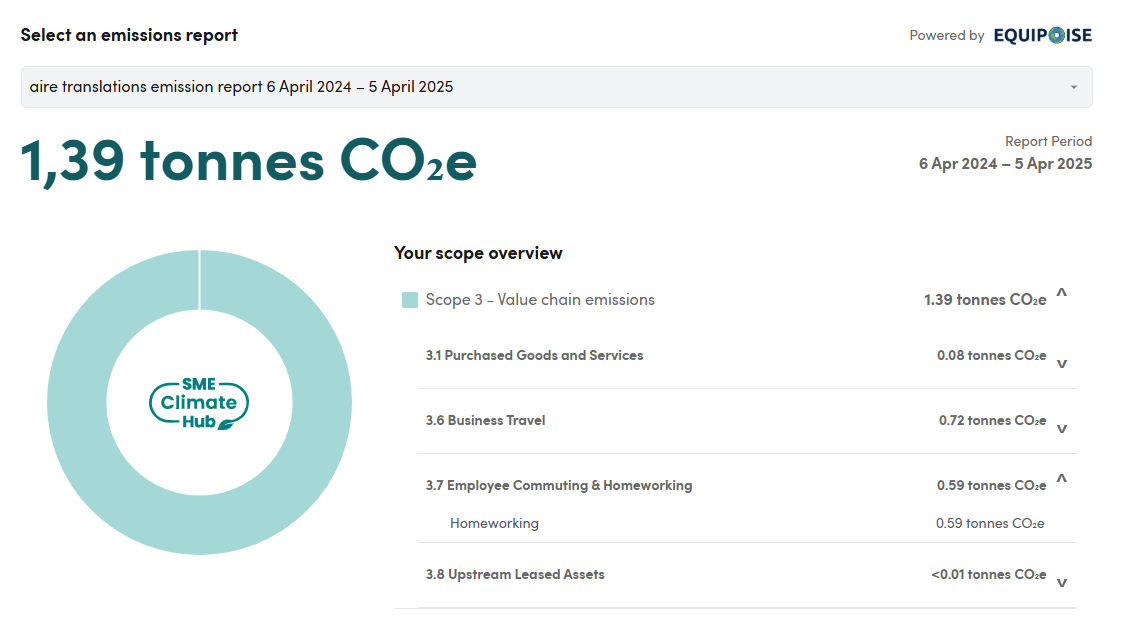
- In the tax year 2024-2025, I donated £130 to the Woodland Trust. For the tax year 2025-2026, I donated £118. However, this only amounts to about half the social cost of my emissions, estimated to be 185 USD/tonne of CO₂e by this study published in Nature. In the future, as my business grows, I plan to donate an amount corresponding to the full cost of my emissions, which I will endeavour to reduce and keep to a minimum.
- Some of the software that I use is provided by companies that don’t align with my values. I’m examining alternatives that allow me to move away from these as much as possible.
- Not all of my clients are committed to sustainability – I am actively pursuing new leads that put the environment in the heart of their actions.
- I need to change my file storage practices to reduce the number of files stored in the cloud and my digital carbon footprint. I do my best to delete unnecessary files, follow good housekeeping practices and make very limited use of AI, but I want to do better.
What I can't do (at the moment)
- Completely avoiding business travel, including air travel to distant locations. Alternatives to air travel tend to be impractical and often impossible due to time and cost constraints. This is why I set myself an annual air travel emissions budget (see above).
- Unfortunately, my professional indemnity policy is underwritten by AXA, which is considered to be the 7th highest underwriter of fossil fuels in the world and a financial supporter of genocide. I have searched for alternatives, but I haven’t found policies with more ethical underwriters that would cover my work for international clients.
- My property uses natural gas. At the moment, going fully electric is cost prohibitive for me.
This policy was last updated on the 30th of July 2026.